Redefining wide-format productivity through automation
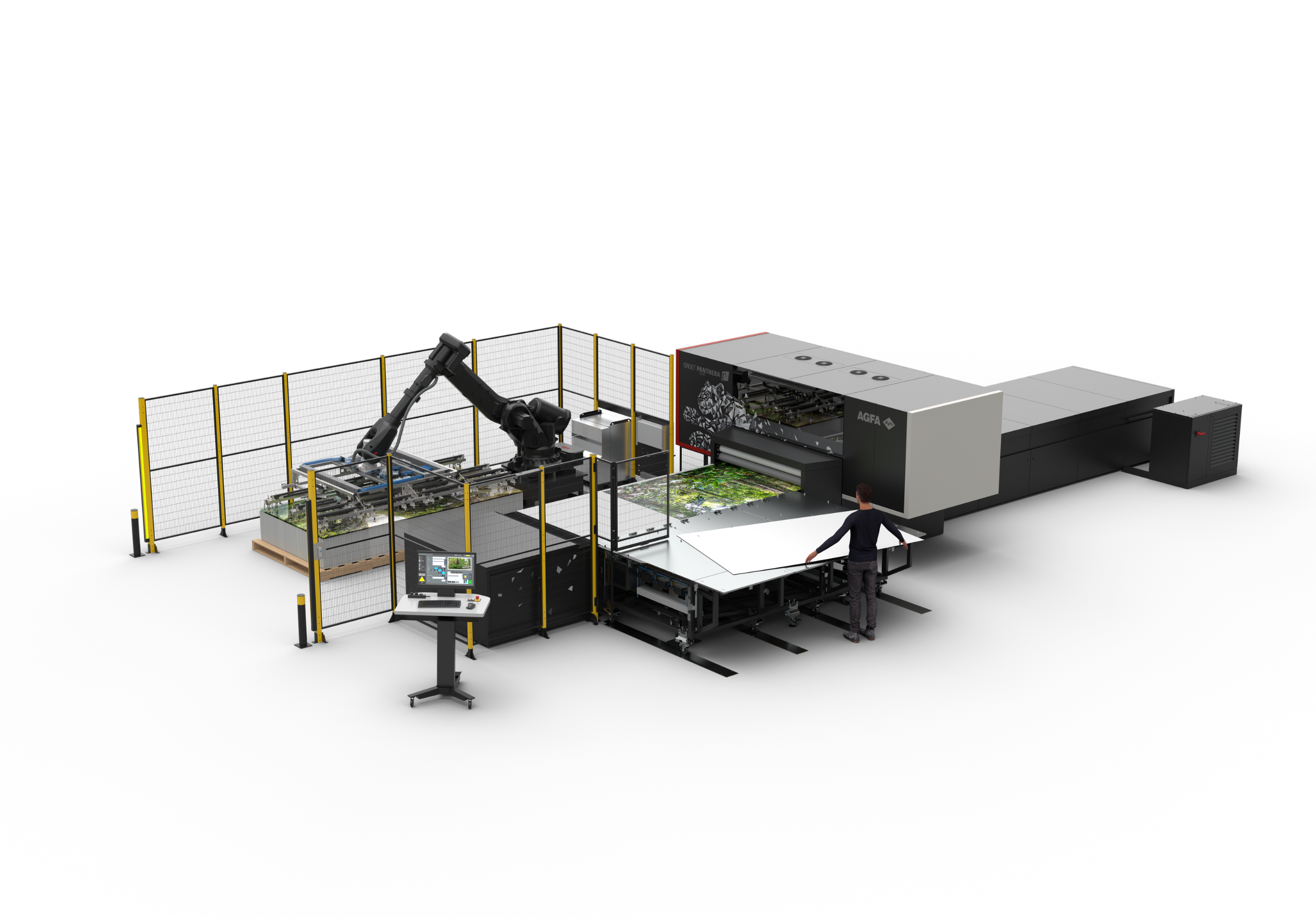
Every second of idle time in wide-format production has a cost. Whether it’s caused by a pause between sheets or a misfeed on a roll line, micro-interruptions can quickly accumulate into real pressure on throughput and profit. Even as software workflows have streamlined file preparation and colour management, the physical side of production often remains fragmented.
Automation brings those physical processes into the same continuous flow as the digital ones. Feeders, stackers, roll systems, and robotics turn stop‑start handling into an uninterrupted flow that enables equipment to sustain speed and consistency across shifts. For print service providers managing tight delivery windows and diverse material demands, that integrated flow is fast becoming the hallmark of competitive production.
Where does efficiency really begin?
Most businesses have already experienced the benefits of digital workflow automation. Modern software platforms mean everything from job submission to colour management can happen automatically. However, the physical flow of material still depends on manual labour.
Loading substrates, checking alignment, even removing finished prints – every manual touchpoint can introduce errors or create bottlenecks that ripple through production. With rising work volumes, just a few minutes lost on each job can translate into hours of downtime per shift.
This is where mechanical automation can make a real difference to productivity. Features like feeders and stackers or robotic loading systems can keep media moving in step with a printer’s maximum speed to ensure production maintains its pace. Rather than being limited by human availability or coordination, production lines become continuous, more predictable operations.
How adaptable is automation to different environments?
There is no single template for automation. Every wide-format press shop is a unique ecosystem with its own mix and types of jobs. The most effective automation strategies recognise this diversity, with modular configurations that enable printers to choose the levels of automation that fit their needs with the capability for expansion as demands grow.
For example, a hybrid printer might begin with manual tables for shorter customised runs and later integrate laytables or unload robots when they need to transition to continuous shift work. Similarly, roll-based systems can start with light-duty automation for occasional use before scaling to fully docked units capable of switching between rigid and flexible materials. This flexibility ensures that automation can be adapted to meet the specific requirements of any given pressroom and adapted as demands evolve.
What happens to the operator’s role?
There is a common misconception that automation removes reliance on operator skills and experience. The reality could not be further from the truth. Automation instead redefines the operator’s contribution by taking care of manual loading and handling, and giving them the freedom to focus on oversight, quality checks, and coordination across multiple printers.
Human skill remains essential in creative decision-making, but machines excel at repeatability. Automated loading and alignment systems eliminate variability from production, ensuring each sheet or roll is positioned exactly the same way, every time. Camera-guided robots and vacuum belts function together to ensure that registration remains consistent across runs, even when printing on heavier or warp-prone materials. What is more, removing physically demanding handling tasks can help to improve workplace safety and ergonomics, directly impacting operator retention and morale.
This shift helps businesses to balance continuity. If one printer pauses for a maintenance check, the operator remains productive elsewhere. Over time this creates a more resilient and scalable production workflow that can better maintain output regardless of any short-term disruptions.
Are investments in automation future-proof?
One of the less immediately obvious advantages of automation lies in its longevity. Industrial-grade robotics are designed for multi-year service life and can often be repurposed when a press is upgraded or replaced. While some handling modules are platform-specific, robots can be redeployed across print lines or even integrated into finishing stations such as cutters or stackers.
This reusability affects return on investment calculations. Rather than being tied to a single machine’s lifecycle, automation equipment can deliver value across multiple production cycles. Combined with the immediate savings from waste reductions and longer uptime, this endurance makes automation one of the strongest strategic decisions available to print operations today.
What does this mean for the future of wide-format print?
Wide-format printing is trending into continuous, industrial-scale production, and efficiency in this environment revolves around how well engineers and handling systems interact. Integrating automation hardware is becoming the standard path to achieving high-volume, low-touch output without compromising flexibility.
For printers, this means being able to confidently plan for growth and run longer production hours while maintaining consistent quality. Although automation does enable things to run faster, perhaps more valuably it helps to create a production model that can scale intelligently and sustainably.
Visitors to FESPA 2026 in Barcelona this May will have the opportunity to see how these principles are already being applied. On stand D100 in Hall 3, Agfa will demonstrate its automated wide-format solutions, including the Onset Panthera with its autoloader and unload robot. This is the ideal chance to see how automation is guiding wide-format production’s future in real time.
About Agfa
The Agfa-Gevaert Group is a leading company in imaging technology and IT solutions with over 150 years of experience. The Group operates through three divisions: Radiology Solutions, Healthcare IT, and Digital Print & Chemicals. They develop, manufacture, and market analog and digital systems for the healthcare sector, for specific industrial applications, and for the printing industry. In 2024, the Group achieved a turnover of € 1,138 million.