Can Pigment Inks Bridge the Gap Between Sustainability and Profit?

Digital textile printing is often slowed by complex, multi-step post-processing. Universal pigment inks offer a sustainable, water-saving alternative compatible with almost all fibres. However, adoption remains stalled by high ink costs and “hand feel” concerns. As environmental regulations tighten, these inks could become the key to efficient, reshored production.
There has been a steady growth in digital textile printing but it still only accounts for a tiny percentage of the overall textile print market. There are a number of reasons for this but one of the most common is that most inkjet printing requires a multi-step process that takes away much of the advantage of digital printing.
Printing to fabric is a much more involved process than, say, printing to a self-adhesive PVC. First, the fabric must be pretreated to hold the ink, which most volume producers prefer to do themselves to avoid the higher cost of buying pretreated fabrics. The printing itself is fairly straightforward. But then there are various post-processing steps that usually involve washing, steaming and ironing, sometimes multiple times depending on the type of ink used. This post-processing ensures that the inks are fully fixed, with a high level of wash fastness, and that any harmful residues are washed away. Naturally this all takes time, which undercuts some of the advantage of using digital printing.
Most of the textile inks in use, whether they are reactive, acid or disperse, are based around dyes, with different dyes being suitable for a specific range of fabrics to ensure the optimum chemical bond with each of the different types of fibre. This also means that textile manufacturers have to invest in multiple machines – one for each type of ink – in order to work with a full range of different fabrics.
However, there is one class of inkjet ink – textile pigment ink – that should be suitable for all types of fabric. This ink consists of individual coloured particles that are encapsulated in a synthetic resin along with binding agents and then suspended in an aqueous carrier liquid. Once jetted, the drops of ink collect on the surface of the fabric – in many cases a pretreatment is required to hold those droplets in place on the fabric surface. After printing, heat is applied to evaporate the water content and melt the resin, which bonds the pigment to the material surface.
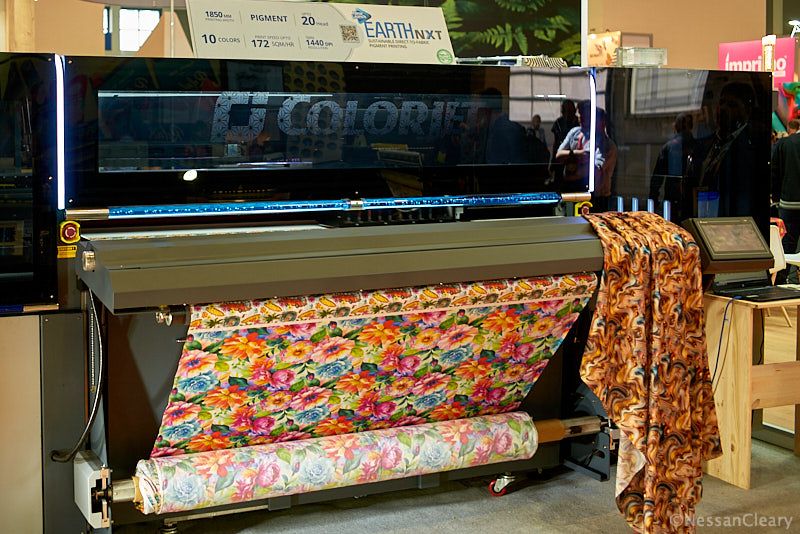
Textile design software copes with problems such as step and repeating patterns across a printed fabric roll
This has two advantages. Firstly, it works with most types of fibre regardless of whether they are natural or synthetic or blends of different fibres. Secondly, since it mostly uses heat to fix the pigment to the fabric it uses considerably less water, making it a much more sustainable approach.
So what’s the catch? The main issue, perhaps not surprisingly is the price, which is considerably higher – almost double in some cases – than that for other types of inkjet textile inks. Most players across the textile industry believe that the price will come down and there has been some drop in pricing over the last couple of years. Nonetheless, there is little sign of any dramatic decrease, despite significant competition from some Chinese ink suppliers. Instead, anecdotal evidence suggests that there is a standoff between the ink suppliers on the one hand, who think that the brand owners will pay more for pigment ink because of its many benefits, and the brand owners on the other side, who are the betting that the price per litre will fall further.
In reality, it’s highly unlikely that the price of pigment ink will fall to the same level as other textile inks because its a more highly engineered ink that costs more to manufacture. That’s because the colourant has to be suspended in a dispersion to stop the pigment particles settling in the bottom of the ink tank or simply bunching together, in order to ensure that the colourant is spread evenly throughout the ink. That said, the pricing will come down as the volumes go up through simple manufacturing economies of scale, but first the demand has to push up the volume being used.
In addition, there are still concerns about the all-important hand feel associated with pigment ink. This is because pigment ink mostly sits on top of the fabric rather than being absorbed into the material and binding with the fibres. It can be argued that this gives a more textured feel to the graphics, which can be a good thing. Equally, this also means that the ink interferes with the feel of the fabric where the graphic lies.
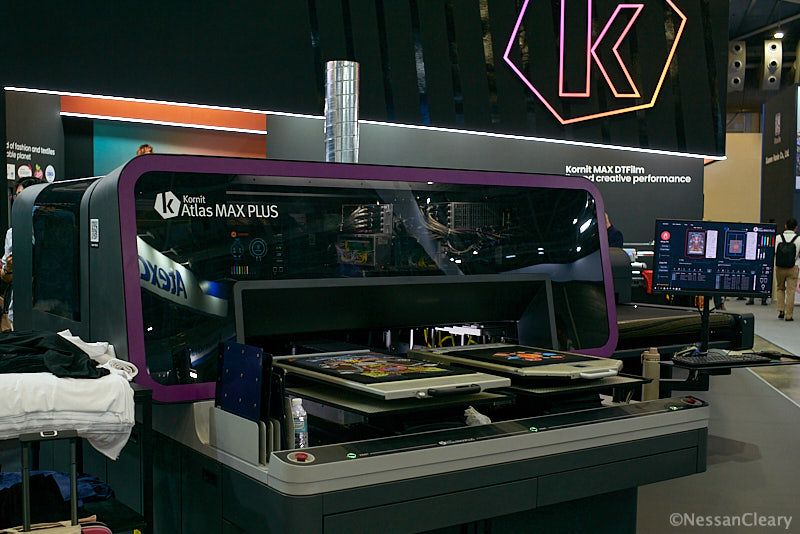
Most DtG printers such as this Kornit Atlas Max Plus use pigment inks
Whether or not this is truly a problem for most consumers lies mostly in the nature of the given fabric, the size of the graphic, and the application in question. After all, most DtF-printed graphics also sit on the fabric surface and can have quite a plasticky feel but this is not a problem for low use applications such as promotional campaigns. It’s much more of an issue for high value garments, where pigment inks are more likely to be used because of the high price of the inks. Still, pigment ink is being used although today that is mostly for the home furnishing market where the overall texture and feel of the ink is less critical. Many commentators believe that the fashion industry is not far behind – once the pricing comes down.
A further reason why existing textile print companies are reluctant to embrace pigment inks is that they’ve already invested in the post-processing equipment and have factored in the time for those assets to depreciate, and in some countries, may have already claimed the tax benefits from this depreciation. That in turn means that most printer vendors see the market opportunity for pigment ink print solutions mainly with new customers that are setting up a completely new textile production line. That includes the European dream of reshoring – that is, bringing textile production back from Asia to Europe and using more advanced technology – like pigment inks – to get around the higher cost of labour.
There is one final factor that is likely to play an outsized role in this, and that is government regulations to reduce the sustainability impact of textile production, particularly around the very high water consumption. This is matched by many western brands having their own sustainability policies. But ultimately, the main arbiter is consumer demand and that is likely to be heavily influenced by price, especially in the current economic conditions.